The main objective of the project was to quantifying the effects of precipitation patterns changes on the rivers solid discharge characteristics and their impact on the coastal area. It focused on the complex system formed by the Danube, its delta and the Black Sea adjacent coastal area.
The projects results are briefly documented hereafter. For more details, please refer to the listed publications or contact the project director.
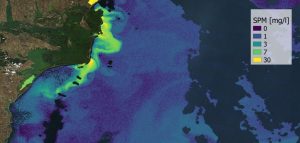
Mapping of Suspended Particulate Matter concentrations based on Earth Observation data
Two new regional algorithms for the estimation of Suspended Particulate Matter (SPM) concentrations were calibrated during the project, using in-situ collected measurements. In terms of satellite data, products available from the OLCI (Ocean and Land Colour Instrument) sensor onboard Sentinel-3 mission were used. It was shown that these datasets have the capability to detect and monitor extreme SPM concentration events in coastal areas. Adaptation of inversion algorithms is still required in order to derive accurate estimates of SPM. The Nechad approach, based on regional coefficients and the merging scheme between 665 nm and 865 nm bands, cannot resolve very high SPM values. The second order polynomial model, empirically determined, cannot predict very accurate for values outside of the training range (app. 100 g/m3). Still, it represents the best approximation available for such high concentrations.
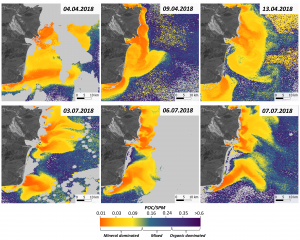
Another significant advancement regarding the usage of satellite information for the study of water quality is represented by the development and application of an innovative method to derive information concerning the composition of the particles assemblages in the water column. This is described by the ratio between the Particulate Organic Carbon (POC) and the total Suspended Particulate Matter (SPM).
Field campaigns
In-situ data collection campaigns were organized, within the D-RAIN project, in Danube Delta. To this regard, the Sfântu Gheorghe Marine and Fluvial Research Station-UB (www.erris.gov.ro/SCMF) existing research infrastructure were used.
A total of 7 field campaigns were organized during the project: November, 2020; January, April, June, October and November 2021; April, 2022.
The following parameters were measured:
- Water turbidity
- Suspended Particulate Matter (SPM)
- Secchi depth
- Water temperature
- Particulate Organic Matter (POM)
- Coloured Dissolved Organic Matter (CDOM)
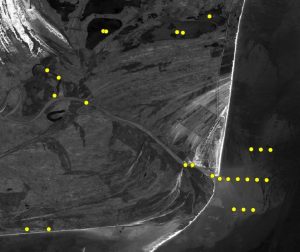
The location of the sampling sites are shown in the figure below. To be noted that most of the locations were used for repeated sampling during various field campaigns.
Changes in the solid discharge patterns as a consequence of precipitation dynamics modifications
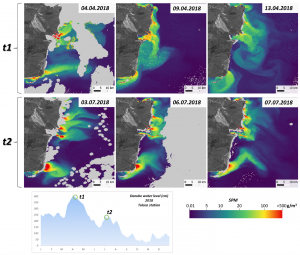
Based on satellite images and in-situ measurements, several events characterized by abnormal high SPM concentrations in front of the river’s mouths were identified. For these events, the distribution of the plume was analyzed, in comparison with other periods when high solid discharge are expected. One example is represented by the event from the beginning of July 2018, when SPM values above 500 g/m3 were registered on the main branches and in the adjacent coastal area. Compared with other moment when the Danube’s liquid discharge was even higher (first part of April 2018, when SPM barely exceeds 100 g/m3, during very high water levels), it was observed that this factor can weight much less than previously though.
When analyzing the precipitation events from few days before this event, it can be noticed that a very high amount of rain fell down in just a short period of time. The figure below shows the percentage of the multi-annual (2000-2021) monthly average precipitations for June that were registered in just one day (June 27, 2018 – few days before the high SPM values at river mouths from the beginning of July), in the eastern part of the Danube’s hydrographic basin. Only values above 30% are represented.
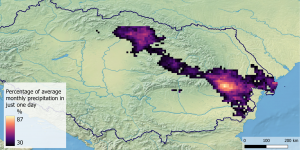
The identified bursts of high SPM could be potentially linked with flash floods located in the Danube’s lower hydrological basin (especially in the sub-basins of rivers downstream of the large dams from Portile de Fier I and II, such as Ialomita, Siret, Prut). They are not necessarily associated with high water levels on the Danube. The sediment plume during these events is characterized by steep Suspended Particulate Matter concentrations gradients at the margins. The same pattern can be observed also for indicators related to particles assemblage composition, such as the ratio between Particulate Organic Carbon and Suspended Particulate Matter. A potential cause for the lower extent of the mineral dominated waters might be linked to different (higher) size of the particles brought by the river in such conditions.